
Hasidic Jews and Psychedelics: Exploring the Search for Spiritual Connection

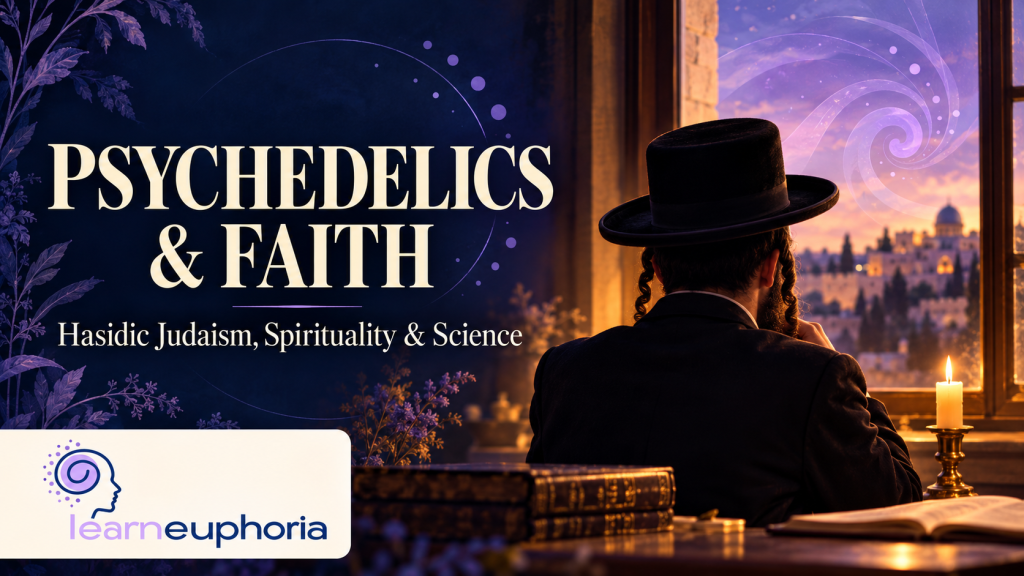
When people picture psychedelic culture, Hasidic Jewish communities probably aren’t the first thing that comes to mind.
That is exactly why a recent Haaretz feature deserves attention.
Published October 17, 2026, Itamar Handelman Smith’s report examines a largely hidden intersection of religious life and psychedelic exploration. Its introduction highlights journalist Madison Margolin’s encounter with the Haredi psychedelic community, challenging familiar assumptions about who explores altered states—and why.
The topic raises a question that reaches well beyond any one religion: Why do some people interpret psychedelic experiences as encounters with the sacred?
At Learn Euphoria, we believe that question deserves education, thoughtful discussion, and respect for the people involved.
Why Psychedelics and Religion Belong in the Same Conversation
Public conversations about psychedelics often focus on mental health treatment or recreational use. Spiritual exploration is another reason people report using these substances.
The National Institute on Drug Abuse recognizes spiritual exploration and self-discovery among the motivations for psychedelic use. It also emphasizes that these substances can produce powerful changes in emotions and perceptions, including both bliss and fear.
For someone who already understands life through a religious framework, an unusual experience of connection, awe, or altered identity may take on religious meaning.
That does not establish that the experience came from God. It does help explain why a person might understand it that way.
We can take someone’s spiritual experience seriously while still asking careful questions about its interpretation.
What the Hasidic Psychedelic Conversation Does—and Doesn’t—Tell Us
The Haaretz feature brings attention to people whose religious identities challenge the stereotype of the psychedelic user.
But a story about particular participants should never become a claim about an entire community.
Individual psychedelic exploration does not establish collective religious approval. Readers should avoid treating the people described in a feature as representatives of all Hasidic Jews, all Haredi Jews, or Judaism as a whole.
There is also a difference between documenting a contemporary practice and establishing an ancient tradition. The existence of Jewish psychedelic communities today does not, by itself, prove that psychedelics were historically part of their religious rituals.
Those distinctions make the conversation more interesting. They allow us to discuss actual people and experiences without turning them into a sensational headline.
How Religious Background Can Shape a Psychedelic Experience
A useful scholarly perspective comes from Sam S. B. Shonkoff’s article in Harvard Theological Review, published online October 6, 2026.
Shonkoff examines psychedelics in neo-Hasidism, which the paper describes as non-Hasidic Jews drawing on Hasidism for spiritual and cultural renewal. This is a distinct subject from contemporary psychedelic use within Hasidic communities. His analysis explores how religious sources shape interpretations of psychedelic experiences—and how those experiences can reshape people’s understanding of religious teachings.
The implication is useful: people bring their histories, expectations, and beliefs into an altered state.
A person’s interpretation may be inseparable from the religious language available to them. That makes blanket statements such as “psychedelics reveal the same spiritual truth to everyone” much harder to defend.
Can Psychedelics Produce Mystical Experiences?
Research supports a carefully worded answer: psilocybin can occasion experiences that participants describe as deeply meaningful or spiritual under controlled conditions.
A landmark 2006 study examined psilocybin in volunteers who regularly participated in religious or spiritual activities. Researchers evaluated its effects in comfortable, supportive conditions and documented experiences with substantial personal meaning and spiritual significance.
That finding matters. It also has limits.
The study does not prove that participants encountered a supernatural reality. Its controlled conditions do not establish that an unsupervised experience will produce the same outcome.
Science can investigate what people report, how their experiences affect them, and whether changes persist. Deciding what those experiences mean theologically is a different question.
A Meaningful Experience Is Not Automatically a Reliable Conclusion
Something can feel profoundly true without every interpretation being accurate.
Johns Hopkins researchers studying people who reported belief-changing psychedelic experiences found changes in beliefs about consciousness, spirituality, meaning, and purpose. The research used retrospective survey responses, so it describes participants’ reported changes rather than proving their new beliefs were correct.
This is where curiosity needs a little humility.
An experience might inspire someone to reconnect with prayer, reconsider their priorities, or feel greater compassion. It might also leave them confused about what happened.
The responsible question is not simply, “How powerful was it?”
It is also, “How carefully have I examined what I think it means?”
Spiritual Intent Does Not Remove Health Risks
A spiritual motivation does not make a substance predictable.
According to NIDA, psychedelic experiences can involve intense fear and major changes in the perception of reality, alongside other health and safety concerns.
Religious sincerity and medical safety answer different questions. Someone may sincerely seek spiritual connection and still experience distress.
That is why education should leave room for uncertainty, individual vulnerability, and the limits of research. A moving personal account should never become a promise that someone else will have the same experience.
What This Means for Psychedelic Education
The intersection of Hasidic Judaism and psychedelics challenges a narrow view of psychedelic culture.
It invites us to ask better questions:
- How does religious identity shape the meaning of an altered state?
- How can communities discuss unusual experiences without stigma?
- How do we respect personal testimony while evaluating evidence?
- What happens when someone’s experience challenges established religious authority?
These questions deserve more than jokes about religious people getting high.
At Learn Euphoria, our perspective is straightforward: education should make room for spiritual curiosity and critical thinking at the same time.
You do not need to dismiss someone’s faith to examine the science. You do not need to accept every spiritual claim to respect the person making it.
Frequently Asked Questions
Do some Hasidic Jews explore psychedelics for spiritual reasons?
The Haaretz feature specifically examines that subject. Its existence should not be taken as evidence that psychedelic use is widespread or accepted throughout Hasidic communities.
Can psilocybin create a spiritual experience?
Controlled research has documented experiences that participants describe as spiritually significant. That does not guarantee such an experience or establish its supernatural meaning.
Does a psychedelic experience prove someone encountered God?
Research can study reported experiences and their effects. Those findings do not establish that a particular theological explanation is true.
Where can I learn more about psychedelics and spirituality?
Explore educational resources at Learn Euphoria, read the underlying research, and distinguish personal testimony from scientific evidence.
Original reporting credit: This commentary was inspired by Itamar Handelman Smith’s October 17, 2026 Haaretz feature on Hasidic Jews, psychedelics, and spiritual connection. Readers are encouraged to visit Haaretz for the complete reporting.
This article is for educational purposes and does not provide medical advice or instructions for substance use.



Responses