
What Ancient Rock Art Can Teach Modern Psychedelic Medicine


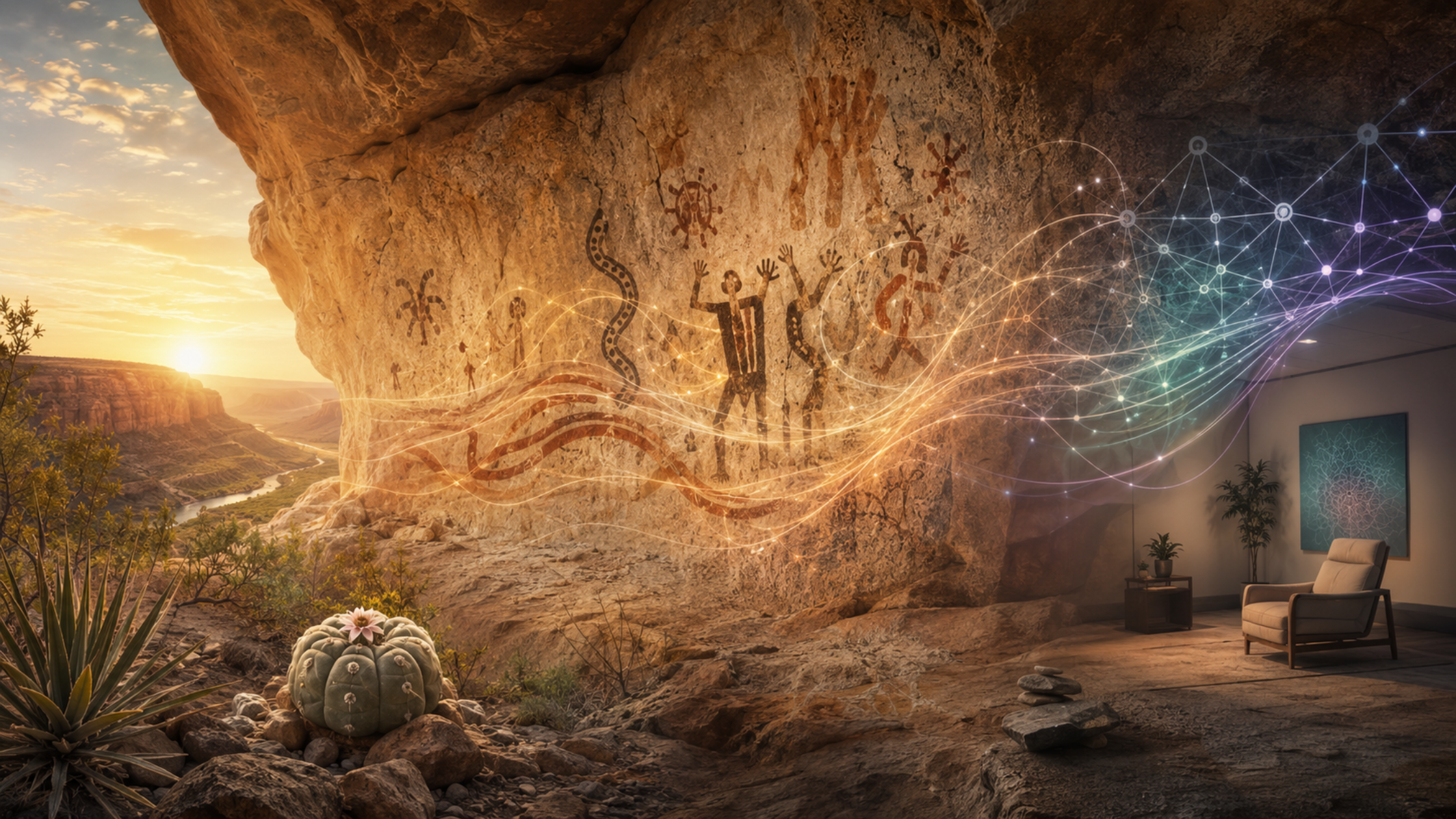
Thousands of years before brain scans and clinical trials, Indigenous communities may have understood psychedelic healing as a relationship among medicine, ritual, community, and place. Ancient rock art in West Texas challenges modern medicine to recover that wider view without romanticizing—or appropriating—the cultures that preserved it.
Ancient Rock Art and Modern Psychedelic Medicine
For modern medicine, psychedelics can look like a collection of molecules waiting to become treatments: psilocybin, mescaline, LSD, DMT. Researchers measure receptors, brain activity, depression scores, adverse events, and the durability of a clinical response.
That work matters. But ancient rock art in the Lower Pecos Canyonlands of West Texas raises a much bigger question: what if the molecule was never the whole medicine?
In a recent essay for Psyche, medical researcher William McCarthy examines millennia-old murals whose imagery may be connected to ceremonial peyote use. The paintings do not offer a clinical protocol, and their exact meanings cannot be known with certainty. What they do preserve is a radically different picture of healing—one involving story, ceremony, landscape, ecology, ancestors, and community.
Modern psychedelic medicine may be new to hospitals and pharmaceutical companies. The human effort to use altered states for healing is anything but new.
The Ancient Psychedelic History Written Into West Texas
The Lower Pecos region sits near the meeting point of the Pecos River and Rio Grande. Its limestone shelters contain elaborate pictographs painted with mineral pigments, including ochre and charcoal. Some figures appear human or animal; others combine features in ways that resist simple interpretation.
Archaeologists have also recovered peyote specimens in caves in the region. The plant material dates to roughly 4,000 BCE, placing evidence of peyote in the same broad archaeological world in which the mural tradition developed.
That does not mean every unusual figure is a picture of a psychedelic vision. Archaeology rarely gives us conclusions that neat. The connection instead comes from multiple strands of evidence: preserved peyote, recurring visual motifs, the murals’ ritual settings, and comparisons made with the traditions of living Indigenous peoples.
Research associated with archaeologist Carolyn E. Boyd has explored similarities between Lower Pecos imagery and the ceremonial knowledge of the Wixárika people, also known as the Huichol. In Wixárika tradition, peyote is not merely ingested as a chemical. Its ceremonial use is connected to pilgrimage, sacred geography, ancestry, the deer, healing, and obligations to a larger living world.
That distinction matters. Calling peyote only “mescaline-containing cactus” may be chemically accurate, but culturally incomplete.
A Healing Tradition That Lasted for Thousands of Years
One of the most astonishing findings about Pecos River-style rock art is its longevity. Radiocarbon research indicates that the tradition persisted for more than 4,000 years—approximately 175 generations—while maintaining a remarkably consistent visual vocabulary.
Imagine any human community returning to the same places, renewing the same images, and transmitting a recognizable system of meaning across four millennia. That kind of continuity suggests more than decoration. The rock shelters may have served as places where knowledge, identity, memory, and ceremony were repeatedly made real.
The landscape was not simply the background for the ritual. The canyons, springs, rivers, caves, plants, animals, paintings, and journeys may all have participated in it.
In contemporary psychedelic language, we often talk about “set and setting.” Set refers to a person’s mindset, expectations, and emotional condition. Setting refers to the physical and social environment. The Lower Pecos murals suggest an even broader frame. Setting can include history, ecology, community, spiritual meaning, and a relationship with place extending far beyond a single treatment session.
In other words, the room matters—but so does the world the room belongs to.
What Modern Psychedelic Medicine Gets Right
The current psychedelic research revival has produced serious and promising work. Clinical studies have investigated psychedelic-assisted approaches for depression, alcohol use disorder, obsessive-compulsive disorder, distress associated with life-threatening illness, and other conditions.
Researchers are also beginning to understand how these experiences may differ from conventional daily medications. Brain-imaging studies suggest that psilocybin can temporarily alter communication among brain networks and loosen rigid patterns associated with rumination. Patients may report a changed sense of self, increased psychological flexibility, or a powerful feeling of connection.
None of this makes psychedelics a universal cure. Results vary, the experience can be psychologically difficult, and risks can be significant for some people. Screening, preparation, professional support, and follow-up remain essential in legitimate clinical settings.
Science is right to test claims rather than accept them on faith. It is right to study dosing, safety, contraindications, mechanisms, and outcomes. Ancient traditions should not be used as a substitute for evidence.
But evidence should not be reduced to chemistry alone.
The Molecule Is Not the Entire Medicine
Two people can receive the same compound at the same dose and have profoundly different experiences. Their trust in the facilitator, expectations, surroundings, personal history, culture, music, preparation, and sense of safety can all influence what unfolds.
This is why psychedelic-assisted therapy cannot be understood in quite the same way as taking an ordinary pill and returning to your day. The experience is not just a pharmacological event. It is also psychological, relational, and often meaning-making.
Ancient ceremonial systems appear to have recognized this complexity without using our scientific vocabulary. Ritual helped establish intention. Community created support and accountability. Story gave the experience a framework. A sacred landscape placed the individual inside something larger than the individual.
Modern healthcare does not need to imitate Indigenous ceremonies. In fact, copying sacred practices without permission or understanding can become another form of extraction. The better lesson is structural: psychedelic care should take context seriously.
That could mean thoughtful preparation, a safe and supportive environment, culturally competent care, time for integration, access to community, and attention to the patient’s values. It could also mean acknowledging that relief is not always experienced merely as “fewer symptoms.” Sometimes it is felt as renewed connection—to the self, to other people, to purpose, or to life itself.
Nature Connection May Be More Than a Side Effect
Many people describe psychedelic experiences in ecological terms: interconnectedness, belonging, awe, reverence, or a sense that the boundary between the self and nature has softened.
Researchers sometimes call part of this phenomenon “nature relatedness.” Studies have explored associations among psychedelic use, nature connection, wellbeing, and pro-environmental attitudes. Those relationships are still being investigated, and a feeling of unity should not automatically be treated as proof of a therapeutic mechanism.
Still, it may be a mistake to dismiss nature connection as decorative scenery around the “real” treatment.
Illness can isolate people. Depression can shrink a person’s world. Cancer, grief, addiction, and trauma can interrupt routines, relationships, identity, and meaning. If psychedelic-assisted care helps some patients feel that they belong to life again, that reconnection may be clinically relevant even when it is difficult to represent on a brain scan.
The Lower Pecos art offers a useful challenge: perhaps healing is not only the repair of an isolated individual. Perhaps it can also involve restoring relationships among person, community, place, and meaning.
The Risk of Turning Sacred Medicines Into “Novel Therapeutics”
As psychedelic medicine attracts investment, the industry has an incentive to produce standardized, patentable, scalable treatments. Standardization can improve safety and make research easier to evaluate. It can also help therapies move through regulatory systems.
But there is a danger in presenting psychedelics as newly discovered pharmaceutical inventions while ignoring the peoples who protected knowledge of these plants through colonization, prohibition, and persecution.
Peyote makes this issue especially urgent. It is central to the religious life of multiple Indigenous communities, and wild populations face ecological pressure. Growing mainstream interest can create new demand without creating respect, conservation, or reciprocity.
A more ethical psychedelic future should therefore include:
- Honest recognition of Indigenous knowledge and history
- Protection of Indigenous religious and cultural rights
- Conservation of threatened sacred plants and habitats
- Research partnerships built on consent rather than extraction
- Cultural humility from clinicians, companies, educators, and consumers
- Access models that do not reserve treatment only for wealthy patients
Respect does not mean making every ancient claim scientifically untouchable. It means understanding that modern institutions are not entering an empty field.
Preserving the Art Is Part of Preserving the Knowledge
The Lower Pecos murals have survived for thousands of years, but survival is not guaranteed. Flooding, climate change, vandalism, development, and other human pressures threaten archaeological sites across the region.
When ancient paintings are damaged, we lose more than attractive images. We lose records of human thought—records created by people whose voices were not preserved in books, medical journals, or corporate archives.
Protecting these sites is therefore connected to the ethics of psychedelic medicine. A society cannot credibly claim to value ancient healing wisdom while allowing the physical places that hold that wisdom to be destroyed.
Preservation should also be led by archaeological expertise and meaningful collaboration with Indigenous communities. These sites are not psychedelic tourist attractions or backdrops for social media. They are vulnerable cultural landscapes.
What Ancient Art Can—and Cannot—Teach Us
Ancient rock art cannot tell a psychiatrist what dose to use. It cannot replace a controlled clinical trial, establish the effectiveness of a treatment, or identify who may be at risk of harm. We should also resist the temptation to project modern ideas onto images created by people living in worlds very different from ours.
But the murals can expose the limitations of our own assumptions.
Modern medicine often separates mind from body, patient from community, treatment from environment, and molecule from meaning. The Lower Pecos tradition suggests that other healing systems may have treated those relationships as inseparable.
The deepest lesson is not that modern clinics should become ancient ceremonies. It is that healing has always been more than a chemical transaction.
If psychedelic medicine is going to mature, it will need rigorous science, ethical regulation, trained professionals, and honest education. It will also need humility. The people who created these murals may not have spoken the language of neuroscience, but they appear to have understood that powerful experiences require preparation, context, relationship, and a story capable of carrying them.
The future of psychedelic medicine may depend not only on discovering what these compounds do to the brain, but on remembering what healing asks of the whole human being.
Frequently Asked Questions
Is the Lower Pecos rock art proof of ancient psychedelic use?
The murals alone are not definitive proof that every image depicts a psychedelic ritual. However, archaeological finds of ancient peyote specimens in the region, the ceremonial character of the sites, recurring imagery, and comparisons with living Indigenous traditions support a serious scholarly discussion about connections among the art, ritual, and peyote.
How old is the peyote evidence found in West Texas?
Peyote material recovered from caves in the region has been dated to roughly 4,000 BCE, making it some of the oldest physical evidence associated with peyote use in North America.
What does “set and setting” mean in psychedelic therapy?
“Set” refers to a person’s mindset, expectations, emotional condition, and intentions. “Setting” refers to the physical, social, and cultural environment. Both may strongly influence a psychedelic experience.
Why is Indigenous knowledge important to psychedelic medicine?
Indigenous communities have preserved ceremonial, ecological, and healing knowledge involving psychedelic plants across many generations. Recognizing that history can help prevent cultural erasure, protect religious rights, support conservation, and encourage more ethical research.
Does this mean ritual is scientifically proven to improve psychedelic therapy?
Not by itself. The ancient evidence does not prove that any particular ritual improves a clinical outcome. It does reinforce a question modern researchers already take seriously: how preparation, environment, relationships, expectations, and integration influence psychedelic experiences.


You must be logged in to post a comment.